Become a Captain: How to Get Your Sailing Licence
Welcome to the ultimate guide to becoming a qualified, confident and self-sufficient bareboat skipper, capable of chartering your own boat and enjoying a relaxing week with your chosen crew.
Updated August 12, 2026
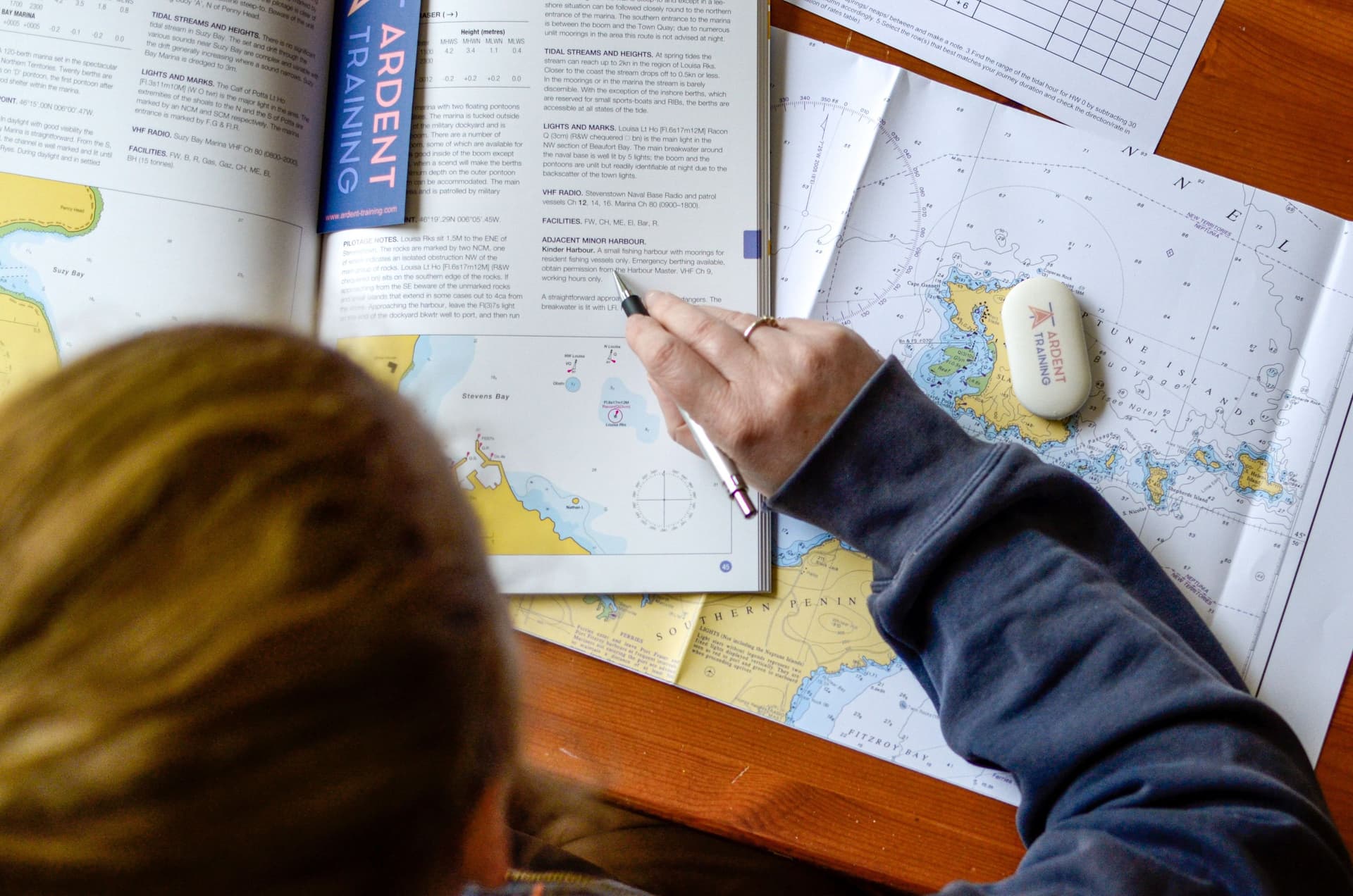
Are you interested in becoming your own skipper? Qualifying to charter bareboat grants you the freedom to explore at your leisure, going where you want and at your own pace.
Fancy stretching your sealegs with some long sailing days? Or prefer a more laid back approach, gently pootling between remote anchorages? The choice is yours!
Charters in the Mediterranean require all bareboat captains to hold a valid sailing licence. We go into more detail on that in our article on sailing licences.
But how do you get qualified in the first instance?
The good news: getting qualified is straightforward. There are three primary routes to go down to become a qualified skipper, depending on your current level of sailing experience, and where you're based.
With the exception of the one-day ICC assessment, which includes theory and practical elements, you will need to complete an online theory course before taking the practical test. Just like a car driving test, but for yachts.
Luckily, with our theory parteners Ardent Training, and practical course partners Prometheus Sailing, we have everything you need to get that bareboat sailing licence, or even simply brush up your skills ahead of the summer season.
How do I know what license is right for me?
The exact training pathway that suits you will depend on several factors - where you are (which courses are available), where you’re likely to be sailing, what your goals are (minimum bareboat requirement, or more formal certification?) and your current sailing skill and experience level.
If you’re new to the sport, you will want to start at the beginning and go through a full training pathway. We recommend the RYA or ASA syllabuses. Certificates from these organisations are generally accepted globally, with a few exceptions.
RYA or ASA Pathway?
Royal Yachting Association (RYA) : British governing body, internationally renowned for the Day Skipper and Yachtmaster certificates. RYA certificates are open to all nationalities, but must be taken at RYA-recognised schools.
American Sailing Association (ASA) : American governing body, issue certificates for bareboat crusing (ASA104) and catamaran sailing (ASA114).
International Certificate of Competence (ICC): internationally-recognised certificate set up by the United Nations. You can convert an RYA certificate to an ICC very easily. Apply for an ICC here
International Proficiency Certificate (IPC) : The US answer to the ICC, this is an internationally-accepted certificate that looks like a driving licence. You can easily convert an ASA certificate to an IPC – Apply for an IPC here
There’s a full list of licences accepted in Croatia available here: Accepted Croatian licenses
*Please note: RYA Day Skipper is not accepted in Greece due to the wording – if you hold one, we recommend you apply online with the RYA to send you an ICC (this service is free for RYA members).
RYA Pathway
The progression:
- RYA Competent Crew (optional but recommended) : Learn the basics: how boats work, essential knots, helming under supervision
- RYA Day Skipper Theory: Navigation, tides, weather systems, safety protocols, passage planning. Take this online before your practical course.
- RYA Day Skipper Practical: Five days on the water learning boat handling, anchoring, pilotage, and skipper responsibilities. This is your minimum bareboat qualification.
- ICC (International Certificate of Competence): Easy to apply for once you reach Day Skipper. Also offered as a standalone course for experienced sailors. Legally required in some European countries.
- Additional: RYA Yachtmaster: The ultimate yacht sailing qualification you can obtain, respected worldwide. Not required for chartering, but exceeds the bar for bareboat charters.
Timeline: 1-3 weeks total (can be intensive or spread out) Why choose this: Maximum flexibility. The RYA Day Skipper with ICC is accepted virtually everywhere and meets legal requirements in the Mediterranean. We work with Ardent Training for online theory courses and Prometheus Sailing in the UK for practical training. We can also connect you with RYA schools in Croatia, Greece, and beyond.
ASA Pathway
The progression:
ASA 101: Basic Keelboat Sailing: Fundamentals and safety
ASA 103: Basic Coastal Cruising: Navigation, anchoring, docking, onboard systems
ASA 104: Bareboat Cruising: Full skipper competence on yachts up to 45-50ft
Timeline: 1-2 weeks (often taught as an intensive liveaboard course)
Why choose this: Very charter-focused. Widely accepted in the Caribbean and by US-based operators. If you're planning to sail primarily in the Americas, this is your most efficient route.
Important note: If you're planning Mediterranean charters, you may still need an International Proficiency Certificate (IPC) as well as your ASA certification. You can convert your ASA 104 to an IPC here.
Australia & Other Nationalities
Australian sailing qualifications aren't always accepted internationally. If you're Australian (or from another country without globally recognised certification), the RYA pathway is your safest bet. Australian Sailing has a partnership with the RYA to allow Australian citizens to access the RYA pathway.
For information on obtaining an ICC within Australia, see the Australian Sailing guidelines.
Fortunately for most sailors worldwide, the RYA have training scholls globally. Train at an RYA school in Australia, Europe, or Southeast Asia, and you'll have paperwork that works everywhere.
Another option is the International Yacht Training (IYT) 'International Bareboat Skipper' qualification. This is recognized by 40 governments worldwide as proof of competence, but we suggest you check with your broker if your operator will accept it. An IYT certificate can be converted to an ICC, provided you've done it with an IYT partner school approved to offer the ICC.
What route is right for you?
Your experience level
Some experience and want formal training
If you’re comfortable on board, have sailed a few days and maybe even have a competent crew certificate or similar, you would also benefit from the structured training of an official course.
The best fit would likely be an RYA Day Skipper course; this 5-day course will equip you to command a 30-45ft sail cruising yacht and its crew on day trips in familiar waters. It is the minimum requirement for chartering a bareboat, and can be easily converted to an ICC for universal acceptance.
The practical course will cover pilotage, practical navigation, seamanship and boat handling. We strongly recommend you take the RYA Day Skipper Theory course first.
We recommend our partners Ardent Training for online theory courses (a pre-requisite for the practical course), and can suggest practical test providers based on your location. In the UK, our preferred partners are Prometheus Sailing in Port Solent, while we also work with fleets in Croatia, Greece and beyond.
Note: If you're planning to sail in Greece, you'll need to apply via the RYA for an ICC.
Experienced sailor in need of a certificate
If you have years of experience and only need a certificate to allow you to charter in the Med, we suggest doing the one-day ICC assessment, which will test your practical seamanship and manoeuvres, as well as passage planning, COLREGS and navigational abilities.
If you’re just a little rusty and in need of sharpening your skills, we can also arrange a 2-day Yacht refresher course.
The main pathways to becoming a qualified bareboat charter skipper all focus on building practical sea time and gaining an internationally recognised sailing certificate.
Where You're Sailing Matters
Experience-Based Approval
Some Caribbean operators will approve skippers without formal certification if you can demonstrate substantial previous experience:
- Detailed sailing CV or logbook
- Recent experience as skipper
- Time on similar-sized yachts
- References from charter companies or previous skippers
They may also require you to demonstrate manouevring abilities on arrival at the base.
Important: This works in the Caribbean but nowhere that legally requires certification. It's also not guaranteed, as each charter company makes their own assessment, and regulations are tightening up. We advise you to get a license to grant you the freedom to bareboat charter wherever you choose.
Fast-track routes
If your goal is to charter as soon as possible, these are the fastest and most efficient routes to a globally-accepted license:
Fast-Track RYA Day Skipper (1-2 Weeks Total)
- Complete Day Skipper Theory online in advance
- 5-day Day Skipper Practical course
- Certificate issued immediately after; then apply for ICC
Total time: 7-10 days
Fast-Track ASA (7-10 Days)
- Combined ASA 101/103/104 liveaboard course
- Real charter-style sailing experience
- Immediate bareboat competence sign-off; then apply for IPC
Total time: 7-10 days
What are my options?
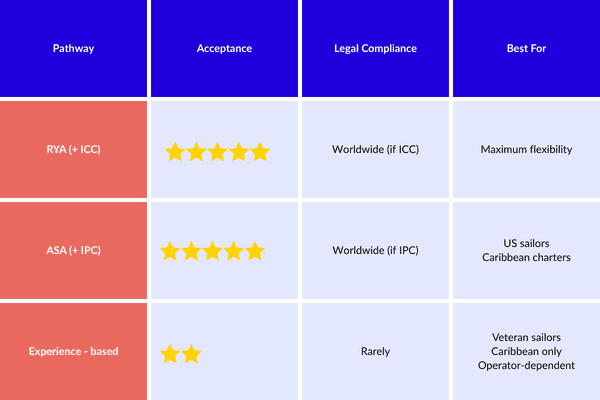
What Charter Companies Actually Look For
Regardless of pathway, most bareboat charter companies assess:
- Sailing and docking ability – Can you actually handle the boat?
- Experience on comparable yachts – Have you skippered something this size before?
- Recent sea time – When did you last sail?
- Formal certification – Strongly preferred, often legally required.
Even with excellent certification, expect questions about your recent experience. Charter companies want to know you can actually do what your certificates say you can do.
Key Takeaways
The Bottom Line
The exact training pathway depends on where you're from, where you're sailing, what your goals are, and your current skill level. But the principle is the same: get proper training from recognised organisations, build real sea time, and obtain certification that's accepted where you want to sail.
Experience matters, but certification avoids charter headaches. Port authorities and charter companies don't care how many nautical miles you've logged if you can't prove it with the right paperwork.
If you want the most reliable and future-proof option, the RYA Day Skipper with an ICC (and a VHF licence) is the gold standard.
ASA 104 or 114 are excellent alternatives for US sailors, but you may want to add an IPC for full freedom.
The experience-based approval may work in less regulated countries for seasoned sailors with strong credentials, but is not recommended.
Ready to Qualify?
We work with training partners globally:
- Theory courses: Ardent Training
- UK practical training: Prometheus Sailing
- Mediterranean training: Contact us for RYA schools in Croatia and Greece
Need more detail on sailing licences? Check out our complete guide to bareboat licences.
Ready to put your new qualification to use? Start planning your first bareboat charter with expert advice from people who've done the sailing.
Need some help?
If you are unsure about charter or boat selection, contact us at Anchor to help you decide.
We only choose boats that are in excellent condition, and we are here to help you every step of the way and to make sure the whole process is as easy as possible.