Mooring in the Caribbean
In most of the Caribbean, you won't be dropping anchor. You'll be tying up to a mooring ball.
Updated August 12, 2026

A practical guide to picking up a mooring ball
There are some wonderful anchorages in the Caribbean, but in the most popular places, you won't be dropping anchor. Especially in deep water or over protected seabed.
You'll be tying up to a Caribbean mooring ball, and in the British Virgin Islands in particular, you'll be reserving one before breakfast.
This guide covers what you actually need to know: where to anchor and where you can't, how the BVI's BoatyBall reservation system works in practice, and the six-step routine for picking up a ball without a shouting match on the foredeck. Give it a quick read and you'll be mastering mooring balls in no time!
All prices, ball types and reservation logic below are accurate as of November 2025 and verified against operator sources.
Always cross-check current rates on BoatyBall before you sail.
A quick orientation
Anchor or mooring?
The Caribbean reality
Across most of the Caribbean: the BVI, USVI, parts of St Lucia, the Grenadines, the BVI marine parks; mooring balls are the default.
These mooring balls are buoys, usually secured to a large concrete block on the seabed, which provide a secure and environmentally-safe way to moor in a bay without using the anchor.
Coral reefs and seagrass beds run all over Caribbean bays, and dropping a hook on either can be illegal, environmentally catastrophic, or both.
Most base teams will brief you on which approach is best; anchoring or picking up a mooring ball/buoy.
Country variance
Some places are more organised than others, especially where demand is high. In some cases it is all first come first serve mooring, while busier BVI spots like Trellis Bay, White Bay, and Cooper Island Beach Club have reservable moorings. A few rules of thumb that hold across the islands:
- BVI: Mooring balls in almost every popular bay. Anchoring is permitted in some sandy patches outside the mooring fields, but reefs and grass are protected. The Norman Island caves, the Indians, and the Rhone are all moored-only.
- USVI National Park (St John): Mooring balls only. Anchoring is prohibited inside park boundaries. Day-use available; overnight mooring balls are $26 per night, payable through pay.gov or the on-site host boats.
- St Lucia (Marigot Bay, Soufrière): Moorings inside the Pitons Marine Management Area are mandatory. A boat boy will usually meet you and help you tie up — agree the fee before you accept the help.
- Grenadines (Tobago Cays): Moorings only inside the marine park. Park rangers collect the fee.
Where you can anchor, the holding is usually decent sand at 15–35 feet. But the moment you see reef heads or dark grassy patches under the boat, move on.
A 50ft chain dragged through staghorn coral does damage no-one wants on their charter!
When to anchor
A handful of anchorages still favour the hook: Norman Island's Benures Bay on a quiet weekday, the sandy patches outside Cane Garden Bay, and sections of Anegada's western shore. Pomato Point is a favourite of ours, a lovely quiet sandy anchorage that's ideal if you're after some of Anegada's famous grilled lobster!
It can be wonderful to drop the hook, if you're confident the bottom is sand and/or good holding. You'll get a proper briefing from the charter base before you leave the dock.
Use at least 4:1 scope, set the anchor properly with reverse thrust, and dive on it if you have any doubt. Caribbean squalls can come in fast.
The BoatyBall System
The British Virgin Islands (BVI) sees more charter traffic than anywhere else in the Caribbean, and the mooring fields fill up fast in peak season.
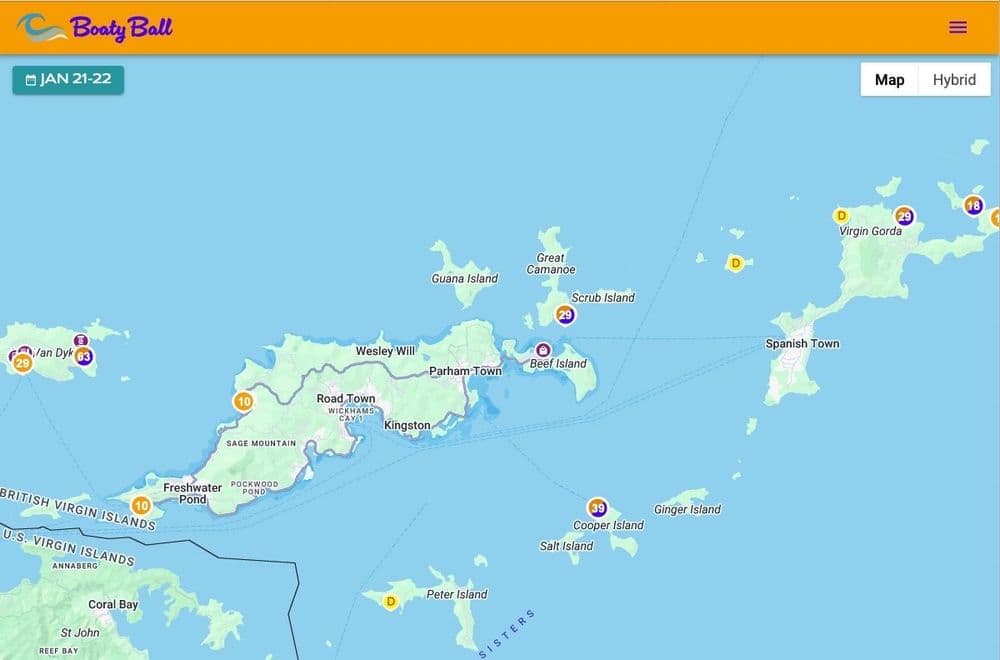
Since 2018, the BoatyBall system has handled overnight reservations in many of the busiest bays. You'll need to know how it works before you arrive at Tortola.
The three ball types:
- Reservable mooring(orange moorings, pear-shaped, numbered, Boaty Ball logo): Booked through the BoatyBall mooring website. $55 per night. Reservations open at 7am local time, same day only, unless you've paid for the upgraded membership tier. Check-in and check-out are both 12pm.
- First Come First Serve mooring (white, with an orange BoatyBall sticker, three-letter ID): Take it if it's free, pay through the app once you're tied up. $30–$40 per night depending on location.
- Day Use Only (white, yellow reflective tape, orange sticker): Lunchtime stops. Donations go to the local organisation maintaining the moorings. Don't sleep on one.
If a ball has a number and is orange and pear-shaped, do not tie up to it unless you have reserved it. Boaty Ball has a policy of suspending accounts and reporting captains who tie up to someone else's reserved ball, and your charter base will hear about it.
How it works
In peak season (December–April), the popular bays, like Cooper Island, Setting Point, and North Sound, the balls are gone within a minute of reservations opening. So you need to be fast! The routine that usually works:
- The night before, agree as a crew where you want to be tomorrow night.
- Set an alarm for 6:55am.
- Open the BoatyBall app, navigate to the bay, and have your finger over the ball you want.
- At 7am sharp, tap. You get four minutes to complete payment.
- Once paid, a red flag appears at your ball. It's yours from midday for 24 hours.
Spotty Caribbean internet can be a real factor. If you've been getting one bar of LTE in the anchorage you slept in, expect the booking page to crash for the first thirty seconds. Have a back-up bay in mind, and be ready to anchor. Once reserved, simply sail to your next stop and get ready to pick up a mooring ball.
The Six-Step Routine
How to pick up a mooring ball
This is the bit that causes more charter arguments than it should! Lots of people worry about the manouevre, but with proper preparation and a clear plan, it shoudl all go swimmingly.
1. Brief the crew before the bay is in sight.
A five-minute conversation gets everyone on the same page. Assign three jobs out loud:
- Helm: drives the boat. Listens to the spotter.
- Spotter: stands at the bow, points at the ball, calls distance and direction in metres or boat-lengths. Hand signals work better than shouting against the wind.
- Boat hook: kneels at the bow, hooks the pennant, threads the line.
Decide your hand signals now. The classic three: arm pointing = direction, palm flat-down = slow, fist closed = stop. Make sure helm and spotter agree before you start!
2. Read the wind and current before you commit.
Caribbean trade winds blow steadily from the east-northeast at 15–25 knots most of the season. Boats on moorings will be lying head-to-wind, which is what you want — approach from downwind so the wind pushes you back if you misjudge.
Look at the boats already moored. Are they lying head-to-wind, or is the current pulling them off-axis? In bays like North Sound or the Bight at Norman Island, the current can do strange things to lighter catamarans. Match the angle of the boats already in place.
3. Approach slowly. Then more slowly.
Idle in gear, no faster than you can step off the boat. If you're approaching at walking pace, you have time to think. If you're approaching at jogging pace, you don't.
On a catamaran, the high freeboard and twin hulls catch the wind badly at slow speeds and you'll drift sideways faster than you expect. The advantage is twin engines; use them in opposition for tight corrections. One forward, one neutral. One forward, one reverse to pivot. Forget the wheel, below 2 knots; you steer on the throttles.
On a monohull, the boat tracks better at slow speeds but carries more momentum once it's moving. You can't stop a 45ft mono on a sixpence. Aim to be in neutral, with the bow drifting toward the ball, by the time the spotter reaches for it. Remember, slow is pro!
4. Hook the pennant, don't grab the ball.
The mooring ball is the float. The thing you actually tie up to is the pennant: the line attached to the top of the ball with a loop (the eye) at the end.
The person on the bow uses the boat hook to lift the pennant up to deck level. Grab the loop, not the ball. The ball is heavy, slippery, and often covered in barnacles.
If the boat hook comes back empty, do not lean further. Tell the helm to circle around for another pass. Falling off the bow in a mooring field is the most embarrassing way to enter a bay!
Catamarans: on most charter cats, the boat hook person stands or kneels on the trampoline between the hulls, not on a bow platform.
The reach to the pennant is longer and the angle is awkward. Move forward to the very tip of the tramp and brace a foot against the crossbeam.
If your cat has a small bow platform on each hull, one spotter on the leeward platform usually has a better angle than someone on the tramp.
5. Rig the lines: bridle on a cat, double line on a mono.
The proceses does vary slightly depending on your yacht, but we advise doubling up your lines to reduce line load and give peace of mind. On a catamaran: rig a bridle. A bridle is two lines, one from each bow cleat, meeting at the pennant. It spreads the load across both hulls, keeps the boat tracking straight head-to-wind, and stops the boat from yawing back and forth in a gusty anchorage. Without a bridle, a cat on a single line will sail around the mooring like a kite. Most charter cats come with a pre-made bridle aboard — a single length of line with a thimble or shackle in the middle that clips into the pennant. If yours does, use it. If not, build one from two mooring lines:
- Tie the first line to your starboard bow cleat with a bowline.
- Run the free end down through the eye of the pennant.
- Bring it back up and tie it off on the same starboard cleat.
- Repeat with a second line on the port cleat.
You now have two lines forming a V from each bow to the pennant. The loop of the pennant should sit 5–7 feet ahead of the bows — far enough forward that nothing rubs against the underside of the trampoline when the boat surges. On a monohull, a single line is enough, but we like to play it safe and run two.
- Tie one end of a mooring line to either bow cleat with a bowline.
- Run the free end down through the eye of the pennant.
- Bring it back up and tie it off on the opposite bow cleat.
- Repeat with a second line.
This forms a double loop through the pennant, taking load on both cleats. The pennant should sit 3–5 feet ahead of the bow — close enough to take the load, far enough that nothing's banging the hull when the boat moves on the swell. Make sure you avoid running a single line through the pennant with both ends back to the same cleat (a "lasso"). It will secure you to the buoy, but chafes the pennant against your hull or bow roller all night. Not enjoyable!
6. Cut the engines and check.
With the lines secured, kill the engines and watch for two minutes. The boat should settle head-to-wind, the lines should be taking even load, and the pennant should be sitting forward of the bow. If anything looks off, sort it now while everyone's still on deck.
Then walk the deck once: are the lines free of chafe points, is anything resting on a sharp bow fitting, are the spare lines stowed. Caribbean nights can pipe up to 25 knots without warning, and a chafing pennant line at 3am is a problem you can't solve from the cockpit.
Local quirks worth knowing
Reef-tied moorings exist in some places. In Anegada and parts of the USVI, moorings are anchored to coral heads rather than concrete blocks. They're inspected less often than you'd like. If the pennant feels weak, the ball looks neglected, or the seabed below is suspicious, move to another ball. The cost of a wrong call here isn't financial.
Boat boys are real, mostly helpful, and need paying. In St Lucia (Soufrière, Marigot), Bequia, and parts of Grenada, you'll be met by a local in a small boat offering to help you moor, tie up to a dock, or buy fruit. Agree the price before you accept the help. $10–$20 USD is normal for a mooring assist. They are usually doing you a favour — pay them.
Squalls. Always squalls. Caribbean squalls roll in fast and pipe up to 35 knots in a few minutes. The mooring blocks are designed for it, but your knots aren't always. If a black cloud is building to windward, walk the deck and re-check your lines before the rain hits, not during.
Lunch stops have their own etiquette. Day-use balls are great for lunch and snorkelling. If you arrive at a popular dive site (the Indians, the Caves, the Rhone) and all the balls are taken, wait. Turnover is fast. Don't tie up to a reservable overnight ball "just for an hour". And never, ever drop your dinghy on a FCFS buoy and motor off in the yacht while 'reserving' your spot. You'll be branded a ‘mooring squatter’; it's terrible etiquette and will not win you any friends in the bar!
Most charter bases brief you on all of this before you cast off. Your skipper briefing at the Anchor base in Tortola or Nanny Cay covers ball types, the BoatyBall app setup, and any local nuances for the bays on your itinerary. Save your questions for then; your briefing skipper has done this thousands of times and knows the bays that bite.
If you're new to picking up moorings and the idea of the 7am scramble doesn't appeal, add a skipper to your charter for the first few days. A professional skipper for two or three days gets you through the busiest legs of the trip, after which you take the helm with everything muscle-memoried in.
Most Anchor bareboaters who add a skipper say it's the best $250 a day they spent.
Ready to sail the Caribbean?
Anchor handles bareboat and skippered charters across the BVI, USVI, St Lucia, the Grenadines, and beyond.
Your broker has sailed these bays, knows which ones get crowded by Tuesday, and can tell you exactly what your week will look like.
Tell us your dates, your crew, and what you've sailed before. We'll come back with three or four boats that fit.
Need some help?
If you are unsure about charter or boat selection, contact us at Anchor to help you decide.
We only choose boats that are in excellent condition, and we are here to help you every step of the way and to make sure the whole process is as easy as possible.